
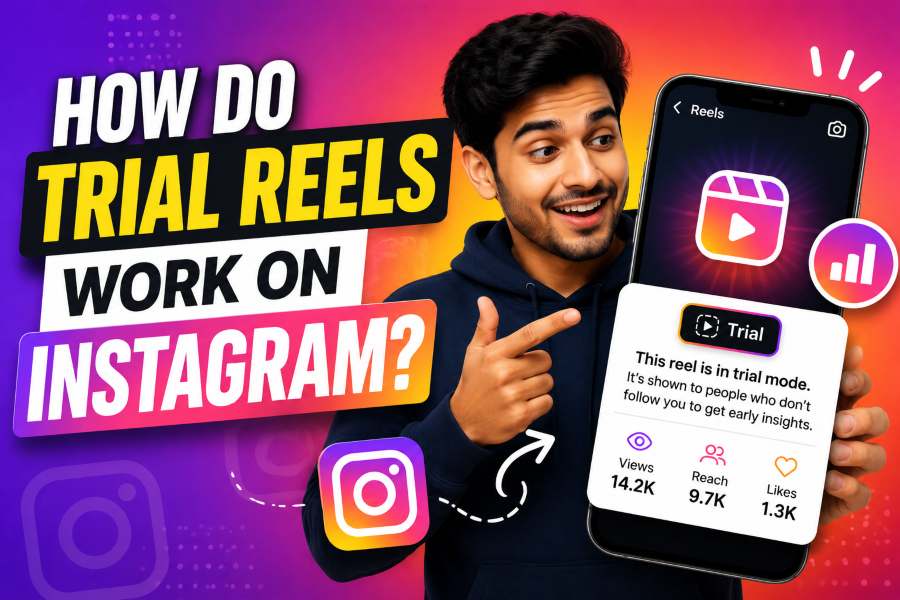
Instagram creators often hesitate to experiment with unfamiliar topics, formats, or editing styles because a poorly performing Reel could disappoint their existing audience. Trial Reels provide a practical solution by allowing creators to test content with people who do not follow them before releasing it to their followers.
So, how do trial reels work on Instagram? You create a Reel normally, activate the Trial option before publishing, and Instagram initially recommends the Reel to non-followers. After approximately 24 hours, you can review engagement data such as views, likes, comments, and shares. You can then share the Reel with everyone manually or allow Instagram to share it automatically if it performs well during the first 72 hours. s feature turns Instagram Reels into a low-pressure testing environment. Instead of guessing whether an idea will work, creators can collect real audience feedback before adding the content to their main profile.
What Are Trial Reels on Instagram?
Trial Reels are Instagram Reels that are shown primarily to people who do not currently follow your account. They let you experiment with content without immediately placing it in your followers’ feeds, your main profile grid, or your public Reels tab.
Instagram introduced the feature to help creators test new genres, storytelling formats, topics, and creative ideas without worrying about how their existing followers might respond. rial Reel works like a small content experiment. Instagram distributes it to a fresh audience and measures how those viewers respond. You receive performance information that can help you decide whether the content deserves wider distribution.
Trial Reels can be particularly valuable when you want to:
- Experiment with a new content niche.
- Try a different video style.
- Test an opening hook.
- Use unfamiliar audio.
- Introduce a new product or service.
- Compare educational and entertaining formats.
- Repurpose an older idea with updated presentation.
- Find content that appeals to non-followers.
The most important difference between a Trial Reel and a regular Reel is the initial audience. A regular Reel may be shown to both followers and non-followers. A Trial Reel begins by targeting non-followers so you can evaluate its ability to attract new viewers.
How Do Trial Reels Work on Instagram Step by Step?
The Trial Reels process is relatively simple. You create the video using the normal Instagram Reel editor and choose the Trial setting before publishing it.
Here is how the complete process works.
1. Create Your Reel
Open Instagram and tap the button for creating new content. Select Reel and record a new video or upload clips from your device.
You can edit the Reel as you normally would by adding:
- Audio or music
- Text overlays
- Captions
- Voiceovers
- Effects
- Filters
- Stickers
- Transitions
- A cover image
You should prepare a Trial Reel with the same level of care as a normal Reel. Although your followers may not see it initially, it will represent your account to potential new followers.
2. Prepare the Reel for Publishing
Once the editing is complete, move to the final sharing screen. Add a clear caption, relevant keywords, hashtags when appropriate, and any necessary topic information.
Check your video carefully before posting. Make sure the first few seconds are engaging, the text is readable, and the message is understandable even to someone who has never visited your profile.
Trial viewers are usually unfamiliar with you. Your Reel should therefore provide enough context for a new viewer to understand the subject immediately.
3. Turn On the Trial Option
Before publishing, find the Trial toggle on the sharing screen and turn it on.
Activating this setting tells Instagram that you want the Reel to be tested with non-followers before being released more broadly. After you publish it, the Trial Reel will appear in the private area of your profile where Instagram also displays drafts and Trial Reels.
Only you can see that the Reel is being used as a trial. It will not immediately appear on your main profile grid or public Reels tab. 4. Instagram Shows It to Non-Followers
Instagram begins recommending the Reel to people who do not follow your account. These users may discover it while scrolling through Reels or through other recommendation areas.
The platform uses viewer responses to understand whether the video is interesting and relevant. Important signals may include whether viewers watch, replay, like, comment on, or share the Reel.
This gives you a useful picture of how your content performs with a cold audience. A cold audience consists of people who do not already know your personality, business, or previous content.
5. Review the Results After About 24 Hours
Approximately 24 hours after publishing the Trial Reel, Instagram provides key engagement information. The available insights can include:
- Views
- Likes
- Comments
- Shares
- Comparisons with previous Trial Reels
These insights help you evaluate whether viewers found the Reel interesting enough to watch and engage with. Instagram may also show how the Reel compares with other trials you have published. id judging a Trial Reel using views alone. A video with fewer views but strong sharing, commenting, or engagement may be more valuable than a video that receives many passive views.
6. Decide Whether to Share It With Everyone
After reviewing the results, you can share the Reel with your followers by selecting the option to share it with everyone.
Once shared publicly, the Reel can appear on your profile and become eligible for broader distribution across Instagram. Your followers may then see it in their feeds, Reels recommendations, and other surfaces. are not required to share every Trial Reel. When a test performs poorly or does not represent your brand properly, you can leave it as a trial rather than pushing it to your followers.
What Is Automatic Sharing for Trial Reels?
Instagram offers an automatic sharing option for creators who do not want to evaluate every Trial Reel manually.
When this option is enabled, Instagram reviews how the Trial Reel performs based on the views it receives during its first 72 hours. If Instagram determines that the Reel is performing well, it can automatically release the video to your followers. You can change this setting when needed. omatic sharing may be useful for creators who:
- Publish several Reels each week.
- Want to reduce manual content management.
- Regularly test multiple creative ideas.
- Prefer data-based publishing decisions.
- Do not want to monitor every test continuously.
Manual sharing gives you more control, while automatic sharing saves time. Brands with strict messaging requirements may prefer to review each result manually. Independent creators publishing frequently may find automatic sharing more convenient.
Can Your Followers See a Trial Reel?
Trial Reels are designed not to appear initially in your followers’ feeds, your main profile grid, or the public Reels tab. However, this does not guarantee that every follower will be completely unable to find the content.
Instagram explains that a follower could still encounter a Trial Reel in another location. For example, someone may send the Reel to them in a direct message, or it may appear on a page associated with the same audio, filter, or location. refore, Trial Reels should not be treated as private content.
Do not use the Trial feature to publish confidential information, unfinished client work, private announcements, or anything you would be uncomfortable having connected to your account. The content is still published on Instagram and can potentially be shared.
What Metrics Should You Check?
Trial Reel insights can help you make better content decisions, but only when you interpret them correctly.
Views
Views show how many times the Reel was played. Strong views may indicate that Instagram found an audience for the content, but views alone do not always prove that people found it valuable.
Likes
Likes provide a quick indication of positive viewer reactions. They are useful, but they generally require less effort than comments, shares, or saves.
Comments
Comments suggest that the content encouraged viewers to respond. Questions, opinions, useful tips, and relatable stories often generate more comments.
Read the comments carefully. They may reveal confusion, objections, follow-up questions, or ideas for future content.
Shares
Shares are especially valuable because they indicate that viewers considered the Reel useful, entertaining, relatable, or worth sending to someone else.
A Reel with strong sharing activity may have greater potential to reach new audiences.
Watch Time and Retention
When available in your insights, watch time and retention help you understand how long people remain interested in the video.
A Reel can receive an initial view but lose viewers within the first few seconds. Weak retention often indicates that the introduction was too slow, unclear, or unrelated to the main message.
Profile Activity
You should also consider whether the Trial Reel encourages people to visit your profile or follow your account. Reaching non-followers is useful, but the greatest long-term value comes when those viewers become part of your audience.
Why Should Creators Use Trial Reels?
Trial Reels are not simply a place to publish content you believe may fail. They are a structured way to improve your content strategy.
Test New Topics Without Confusing Followers
Your followers may expect content about a specific subject. Suddenly posting something unrelated could reduce engagement or create confusion.
A Trial Reel lets you test the new topic with non-followers first. When the response is positive, you have evidence that the topic may deserve a place in your regular content plan.
Compare Different Hooks
The opening seconds of a Reel strongly influence whether viewers continue watching. Trial Reels allow you to test different introductions.
For example, you could create separate versions using:
- A direct question
- A surprising statement
- A common mistake
- A quick demonstration
- A before-and-after result
- A clear promise
Change only one major element at a time. This makes it easier to identify why one version performs better.
Test New Formats
You can compare face-to-camera videos with tutorials, screen recordings, list-style videos, voiceovers, demonstrations, or short stories.
A format that feels unfamiliar to your followers may perform extremely well with new audiences.
Reduce Pressure Around Experimentation
Creators sometimes avoid posting because they are afraid of receiving low engagement. Trial Reels reduce this pressure by separating the initial test from the main follower experience.
Meta reported in June 2025 that, after trying Trial Reels, 40% of the creators it studied began posting Reels more frequently. Among those creators, 80% experienced increased Reel reach from non-followers. Meta notes that these figures describe its internal analysis and do not guarantee individual results. Build a Data-Driven Strategy
Instead of relying entirely on assumptions, Trial Reels let you collect performance information from real viewers.
Over time, you may identify patterns involving:
- Strong opening lines
- Ideal video length
- Popular topics
- Effective calls to action
- Successful editing styles
- Useful audio choices
- Viewer questions
- Shareable content formats
These patterns can guide both your Trial Reels and your regular Instagram content.
How to Use Trial Reels for Content Testing
Random experimentation can produce confusing results. A simple testing method provides more useful information.
Start by selecting one element to test. You might test the hook, video length, topic, editing pace, cover style, audio, or call to action.
Keep the rest of the content reasonably consistent. When two videos differ in every possible way, you cannot determine which change affected the result.
Record your findings in a spreadsheet or content planning document. Include the publication date, topic, hook, format, length, views, comments, shares, and final decision.
After publishing several trials, compare similar videos. Do not make major decisions based on a single test because performance can vary depending on audience behavior, timing, competition, and recommendation patterns.
Best Practices for Better Trial Reel Results
Start With a Strong Hook
Give viewers an immediate reason to continue watching. Introduce the problem, benefit, result, or question within the opening seconds.
Avoid long introductions that require viewers to already know who you are.
Make the Video Understandable to New Viewers
Trial Reels reach people who may have no knowledge of your account. Avoid unexplained references to old posts, ongoing conversations, or inside jokes.
Present the topic as though the viewer is encountering your content for the first time.
Add Readable On-Screen Text
Many users watch short videos without sound. Use clear text to communicate the main point, but avoid covering the screen with long paragraphs.
Use short phrases, readable sizing, and enough display time for viewers to understand each message.
Deliver the Promised Value
Your opening hook should accurately represent the video. Misleading hooks may attract initial attention but reduce trust and watch completion.
When you promise three tips, provide three useful tips. When you promise a demonstration, show the demonstration clearly.
Include a Relevant Call to Action
Tell viewers what to do next without making the ending feel overly promotional.
Possible calls to action include:
- Follow for more tutorials.
- Share this with a friend.
- Save this for later.
- Comment with your experience.
- Visit the profile for the complete guide.
Optimize Your Profile Before Testing
A successful Trial Reel may send new visitors to your profile. Make sure your bio clearly explains who you help and what type of content you publish.
Your recent posts should support the promise made by the Trial Reel. A confusing or incomplete profile can prevent interested viewers from becoming followers.
Common Trial Reel Mistakes
One common mistake is posting low-quality content simply because followers will not see it immediately. Non-followers still form an opinion about your brand, so every published Reel should meet a reasonable quality standard.
Another mistake is testing too many variables at once. Changing the hook, topic, music, length, and editing style simultaneously makes the results difficult to interpret.
Creators may also share a Reel with everyone too quickly. Giving the trial enough time to collect useful data generally produces a clearer picture than making a decision after a few minutes.
Do not assume that every high-performing trial should become a major content series. Test the subject repeatedly before changing your complete strategy.
Finally, remember that Trial Reels do not guarantee viral reach. They provide testing opportunities, not guaranteed views, engagement, customers, or followers.
Trial Reels vs. Regular Reels
A regular Reel is published directly to your account and may reach followers and non-followers. It can appear on your profile grid or Reels tab immediately, depending on your publishing choices.
A Trial Reel is initially used as a controlled test with non-followers. It remains away from your main profile presentation until you decide to share it more broadly.
Use a regular Reel when:
- The content matches your established strategy.
- You want followers to see an announcement.
- The video is part of an existing series.
- The message is designed specifically for your community.
- You are confident the topic is relevant.
Use a Trial Reel when:
- You are testing a new niche.
- You want to compare creative approaches.
- The format is different from your normal content.
- You want feedback from an unfamiliar audience.
- You are unsure whether the topic deserves wider distribution.
Both formats can be part of the same Instagram strategy. Trial Reels help with experimentation, while regular Reels support consistent communication with your existing community.
How Trial Reels Fit Into a Wider Social Media Strategy
A strong social media strategy should combine testing, publishing, analysis, and community engagement.
Trial Reels help with the testing stage. Once you identify a successful idea, you can adapt it into regular Reels, Stories, carousel posts, short videos for other platforms, or longer educational content.
The comments and questions generated by Trial Reels can also inspire future topics. When several viewers ask the same question, create a follow-up Reel that answers it.
Managing communities on other social platforms may require different engagement features. For example, Facebook group administrators can read this guide explaining how to tag everyone in a Facebook group when they need to notify members about an important group update.
Using platform-specific tools correctly helps you reach audiences without relying on the same strategy everywhere.
Frequently Asked Questions
How do Trial Reels work on Instagram?
Trial Reels are shown to non-followers first. After approximately 24 hours, the creator can review metrics such as views, likes, comments, and shares. The Reel can then be shared with followers manually or automatically when Instagram determines that it performed well during the initial evaluation period.
Do Trial Reels appear on your profile?
A Trial Reel does not initially appear on your main profile grid or public Reels tab. It appears privately in the area where you can manage drafts and Trial Reels. It can appear publicly after you share it with everyone.
Can followers see Trial Reels?
Followers do not normally see Trial Reels in their feeds or your Reels tab during the testing stage. However, they could encounter one through a direct message, shared audio page, location page, filter page, or another sharing method.
How long does an Instagram Trial Reel last?
Instagram provides important performance information after approximately 24 hours. When automatic sharing is enabled, Instagram may evaluate views during the first 72 hours before deciding whether to share the Reel with followers.
Do Trial Reels get more views?
Trial Reels do not guarantee more views. They are designed to test content with non-followers and provide performance information. Results depend on the quality, relevance, originality, presentation, and viewer response to the Reel.
Should I use hashtags on Trial Reels?
You can use relevant hashtags when they help explain the subject, but avoid adding unrelated or excessive hashtags. Clear content, strong viewer retention, useful information, and genuine engagement remain important.
Can businesses use Trial Reels?
Businesses can use the feature to test product demonstrations, educational videos, new messaging, campaign ideas, customer problems, and different calls to action when the Trial option is available on their account.
Can I delete a Trial Reel?
You can manage Trial Reels from your profile. Before deleting one, consider recording its performance information so you can use what you learned in future content tests.
Are Trial Reels private?
No. Trial Reels are published to non-followers and should not be considered private. Avoid including confidential, personal, restricted, or unfinished information.
Why is the Trial Reel option not showing?
Make sure the Instagram app is updated and restart the application. Feature availability and interface placement can sometimes vary between accounts. Check the final Reel sharing screen carefully for the Trial option.
Final Thoughts
Understanding how do trial reels work on Instagram can help creators experiment without immediately changing the experience of their existing followers.
The process is straightforward: create a Reel, activate Trial, publish it to non-followers, review the results, and decide whether it should be shared with everyone. The feature gives creators a valuable opportunity to test hooks, topics, formats, and creative ideas using real audience responses.
Trial Reels work best when they are treated as structured experiments rather than shortcuts to viral growth. Focus on one test at a time, track meaningful metrics, study viewer feedback, and apply what you learn to future content.
By combining thoughtful experimentation with consistent publishing, a clear profile, and useful content, Trial Reels can become an effective part of a long-term Instagram growth strategy.